
 admin
Quick Answer
B2B lead generation is the process of identifying businesses that could benefit from your products or services, finding the right people within those companies, and engaging them to create potential sales opportunities.
It involves defining your ideal customer profile (ICP), researching target accounts, finding relevant decision makers, collecting accurate contact information, and reaching prospects through channels such as cold email, LinkedIn, SEO, referrals, and paid advertising.
For example, a company selling sales engagement software might target growing B2B SaaS businesses, identify their Heads of Sales, and contact them with a relevant solution to improve outbound sales productivity.
The goal is not to collect as many contacts as possible. It is to find companies with a genuine need, reach the right people, and turn relevant conversations into qualified opportunities.
Key Takeaways
- Start with your ICP: Define the industries, company sizes, locations, and roles most likely to purchase your product.
- Use multiple acquisition channels: Combine SEO, cold email, LinkedIn, referrals, webinars, and paid advertising where they make sense.
- Separate leads from opportunities: A contact in your database is not automatically a qualified prospect.
- Prioritize data quality: Relevant, accurate contact information is more useful than a large list of outdated records.
- Match your message to the buyer: Explain why your product is relevant to that particular company or role.
- Build a repeatable workflow: Connect prospect discovery, research, outreach, qualification, and sales follow up.
- Measure revenue outcomes: Track qualified opportunities, meetings, conversion rates, and acquisition costs instead of focusing only on lead volume.
What Is B2B Lead Generation?
B2B lead generation is the process of identifying and attracting potential customers for businesses that sell products or services to other businesses.
A lead can be a person or an organization that may eventually become a customer. However, a website visitor, newsletter subscriber, or contact found in a prospecting database is not automatically a qualified lead.
Consider a company that sells project management software to marketing agencies.
Its potential customers might include:
- Marketing agencies with 10 to 100 employees.
- Agency founders responsible for purchasing decisions.
- Operations managers handling project delivery.
- Marketing directors managing multiple client accounts.
The company needs to identify agencies that fit its target market and find the professionals involved in evaluating software.
It can then reach those prospects through cold email, LinkedIn, search engines, industry events, partnerships, and other relevant channels.
B2B Lead Generation vs. B2C Lead Generation
Both approaches aim to attract potential customers, but they differ in their audiences, buying processes, and communication methods.
| Factor | B2B Lead Generation | B2C Lead Generation |
|---|---|---|
| Target audience | Businesses and professionals | Individual consumers |
| Decision makers | Often multiple stakeholders | Usually an individual or household |
| Buying cycle | Often longer | Often shorter |
| Purchase value | Frequently higher | Usually lower per transaction |
| Communication | Business focused | Consumer focused |
| Main channels | LinkedIn, email, SEO, events | Social media, search, advertising |
| Qualification | Company fit, authority, need, budget | Personal interest and purchase intent |
For example, selling CRM software to a company with 500 employees may involve discussions with sales managers, IT teams, procurement, and senior management.
Selling an individual consumer product may require a much simpler purchasing decision.
This difference is why B2B businesses need a structured approach to account research, stakeholder identification, engagement, and qualification.
How Does B2B Lead Generation Work?
A B2B lead generation process connects marketing and sales activities into a repeatable workflow.
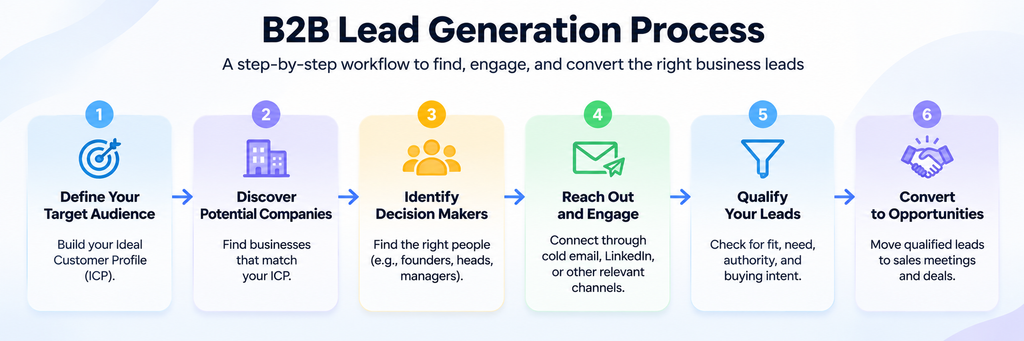
It typically involves six stages.
1. Define Your Target Audience
Identify the businesses most likely to benefit from your product. Consider their industry, company size, revenue, location, technology requirements, and business challenges.
These criteria form your ideal customer profile.
2. Discover Potential Companies
Build a list of businesses that match your ICP. Use company websites, LinkedIn, industry directories, business databases, and other relevant research sources.
3. Identify Decision Makers
Find the professionals responsible for evaluating or purchasing your type of solution. Depending on the product, these could be founders, CEOs, department heads, procurement managers, or sales directors.
4. Find and Verify Contact Information
Collect relevant professional information, including work email addresses, job titles, company websites, and LinkedIn profiles.
Check whether the information is current and whether the contact is appropriate for your campaign.
5. Engage Potential Customers
Reach prospects through personalized cold email, LinkedIn conversations, webinars, telephone calls, or educational content.
The objective is to start a meaningful business conversation, not simply to send a sales pitch.
6. Qualify and Convert Leads
Evaluate the prospect’s company fit, business requirements, purchasing authority, interest, and potential buying timeline.
Move suitable prospects into your sales pipeline and continue engaging them until they are ready to make a purchasing decision.
Important: Lead generation does not end when someone enters your database. The process continues through qualification and the creation of genuine sales opportunities.
Types of B2B Leads You Should Know
Understanding lead classifications helps marketing and sales teams decide how to prioritize prospects.
There are two useful ways to classify leads: their qualification status and their level of engagement.
1. Marketing Qualified Leads (MQLs)
Marketing qualified leads are prospects who have demonstrated interest through marketing activities but may not yet be ready for a direct sales conversation.
For example, someone who downloads an industry report, subscribes to a newsletter, or attends a webinar could become an MQL.
2. Sales Qualified Leads (SQLs)
Sales qualified leads are prospects evaluated by the sales team and considered suitable for direct sales engagement.
For example, a company that requests a product demonstration, explains its requirements, and has the authority to purchase may qualify as an SQL.
3. Product Qualified Leads (PQLs)
Product qualified leads are users who have experienced a product and demonstrated meaningful interest through their usage.
For example, someone using a free trial who repeatedly explores premium features or invites additional team members could be a PQL.
4. Cold Leads
Cold leads are potential customers who have not previously interacted with your business.
They may match your ICP, but you have not established a relationship with them. Cold email, LinkedIn prospecting, and professional networking are common ways to engage these prospects.
5. Warm Leads
Warm leads have already demonstrated some interest in your business.
They may have visited your website, interacted with your content, attended an event, or responded to an earlier outreach message.
6. Hot Leads
Hot leads demonstrate strong buying intent.
For example, a prospect who requests a quotation, asks about implementation, or wants to discuss contract terms may be ready for a sales conversation.
Important distinction: MQL, SQL, and PQL describe qualification models or stages. Cold, warm, and hot describe a prospect’s level of familiarity or buying readiness. These classifications can overlap.
How to Generate B2B Leads: 10 Strategies That Work
There is no single lead generation channel that works for every business.
A SaaS company selling enterprise software may rely on account based marketing and targeted outbound campaigns. A consulting firm may generate more opportunities through referrals, LinkedIn, and educational content.
The right combination depends on your target market, budget, product, sales cycle, and available resources.
Here are ten practical strategies to generate B2B leads.
1. Define Your Ideal Customer Profile (ICP)
Before searching for prospects, understand exactly which businesses you want to reach.
An ideal customer profile describes the characteristics of companies that are most likely to benefit from your product or service.
For example, if you sell cold email software, your ICP might look like this:
| Attribute | Target Criteria |
|---|---|
| Industry | B2B SaaS and technology |
| Company size | 11 to 200 employees |
| Location | United States, United Kingdom, Canada |
| Revenue | $1 million to $50 million |
| Job titles | Founder, CEO, Head of Sales |
| Business need | Generating outbound sales opportunities |
| Technology | CRM and sales engagement software |
These criteria give your sales team a clear direction when researching potential customers.
You can also create separate ICPs for different customer segments. Startups may prioritize affordability and ease of implementation, while enterprise businesses may focus on integrations, security, reporting, and team management.
Practical tip: Start with one specific segment instead of targeting every industry and company size simultaneously. Review the results of your first campaign, identify which companies generate meaningful conversations, and expand your targeting based on that evidence.
2. Use a B2B Lead Finder to Discover Potential Customers
Manually researching companies and finding decision makers can consume a significant amount of time.
A B2B lead finder simplifies this process by allowing you to search for businesses and professionals using specific prospecting filters.
Depending on the platform, you can search using:
- Job title and department.
- Management level.
- Industry.
- Company size.
- Company revenue.
- Location.
- Technologies used.
- Funding stage.
- Professional experience.
For example, imagine you sell marketing automation software and want to reach marketing leaders at growing SaaS companies.
Your search criteria could look like this:
| Filter | Selection |
|---|---|
| Job title | Head of Marketing, Marketing Director |
| Industry | Software and Technology |
| Company size | 51 to 200 employees |
| Location | United States |
| Management level | Director and above |
A prospecting platform can then return matching companies and professionals, depending on its database coverage.
How B2BFinder Helps You Find Relevant B2B Leads
B2BFinder helps sales and marketing teams discover business contacts, identify decision makers, verify professional email addresses, and build targeted prospect lists.
According to its website, B2BFinder offers a database of 150M+ B2B contacts and 25+ search filters. These are platform-reported figures, not a guarantee that every contact will match your campaign or have a deliverable email address.
Useful capabilities include:
- People and company search: Research professionals and businesses that fit your ideal customer profile.
- Advanced filters: Narrow your search by relevant criteria such as job title, industry, location, company size, revenue, and technology where available.
- Decision-maker discovery: Focus on founders, executives, directors, and other roles involved in buying decisions.
- Real-time email verification: Check business email deliverability before outreach; verification reduces uncertainty but cannot guarantee delivery.
- Saved prospect lists and exports: Organize selected contacts and export data according to your account’s available options.
Example prospecting workflow
Suppose you sell sales engagement software and want to reach Heads of Sales at US-based SaaS companies with 50 to 200 employees.
| Step | Action |
|---|---|
| 1 | Open B2BFinder and start a people or company search |
| 2 | Select the United States as your target location |
| 3 | Narrow the industry to SaaS or relevant software businesses |
| 4 | Set the company-size range, where supported |
| 5 | Look for Heads of Sales and related decision-making roles |
| 6 | Review results and verify available business email addresses |
| 7 | Save or export suitable prospects for a segmented outreach campaign |
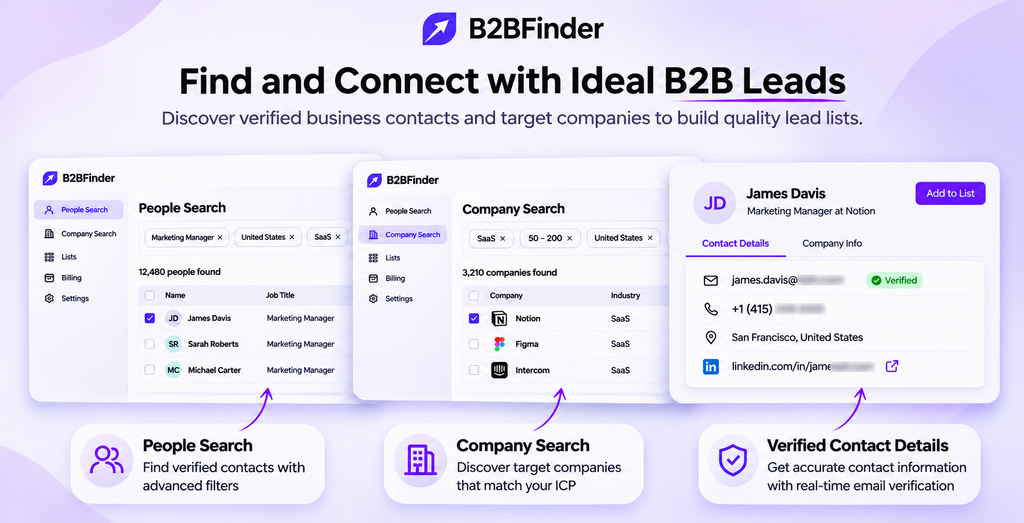
The important thing is to use prospecting filters around your ICP instead of collecting every available contact. A larger database does not automatically mean a better lead list.
CTA: Ready to build a more targeted prospect list? Explore B2BFinder to find decision makers, check business emails, and prepare contacts for your outreach workflow.
3. Generate Leads Through LinkedIn
LinkedIn is a valuable B2B prospecting channel because professionals use it to discuss business challenges, share industry updates, and connect with people in their industries.
You can use it to identify potential customers, understand their responsibilities, and start relevant conversations.
Here is a practical approach.
Step 1: Search for relevant decision makers
Use LinkedIn search or Sales Navigator to identify professionals based on job title, company, industry, and location.
Step 2: Review their profiles
Look at their current responsibilities, company information, professional experience, and recent activity.
Step 3: Identify a relevant reason to connect
Avoid sending connection requests that immediately pitch your product.
Instead, refer to something relevant about their company, role, or professional interests.
Step 4: Start a conversation
Once they accept your request, ask a relevant question or share something useful.
Step 5: Introduce your solution when appropriate
If the prospect mentions a relevant business challenge, explain how your product or service could help.
Example LinkedIn message
Hi Sarah,
I noticed your team is expanding its outbound sales operations. I was curious whether you are currently using a dedicated platform to manage prospecting and email outreach.
Would be interesting to hear how your team approaches it.
The objective is to start a relevant conversation rather than immediately push a sales pitch.
4. Use Cold Email to Reach Potential Customers
Cold email is one of the most direct ways to reach B2B decision makers.
It allows you to introduce your product or service to relevant prospects even when they have never interacted with your business.
However, sending thousands of generic emails is not a reliable lead generation strategy.
Your targeting, contact data, messaging, and follow up process all influence campaign performance.
A practical cold email process looks like this:
- Build a list of companies matching your ICP.
- Identify relevant decision makers.
- Find and verify their professional email addresses.
- Research each prospect’s company and potential requirements.
- Write a short, personalized email.
- Follow up appropriately if they do not respond.
- Track positive replies and qualified opportunities.
Example of a B2B cold email
Subject: Improving outbound prospecting at {{company}}
Hi {{first_name}},
I noticed that {{company}} is expanding its sales team.
I wanted to reach out because growing sales teams often need an efficient way to find relevant decision makers and manage outbound campaigns.
We help B2B teams simplify their prospecting and outreach process.
Would you be open to a quick conversation about how your team currently handles outbound prospecting?
Best,
{{your_name}}
Adapt the message to the actual prospect. Do not use company information or business observations that you have not verified.
Also, follow applicable email marketing, privacy, and data protection requirements.
Practical tip: Measure positive replies and qualified meetings rather than celebrating the number of emails sent. A campaign that generates fewer but more relevant conversations may be more valuable than one that generates hundreds of uninterested responses.
For better outreach results, verify your prospect list before sending and tailor each message to the recipient’s role and business context.
5. Create SEO Optimized Content
Search engine optimization can help your business attract potential customers who are already researching problems related to your product or service.
For example, a company selling CRM software could publish content around:
- Best CRM software for small businesses.
- How to manage customer relationships.
- CRM vs spreadsheets for sales teams.
- How to organize a sales pipeline.
- Sales management tips for growing businesses.
These topics can attract people researching solutions to problems your product addresses.
However, not every website visitor will become a lead.
To convert relevant traffic into potential customers, offer useful next steps such as:
- Downloadable industry reports.
- Free templates.
- Product demonstrations.
- Free trials.
- Consultation requests.
Practical example:
Imagine a company publishes an article about managing sales pipelines.
Instead of ending the article without a next step, it could offer a downloadable sales pipeline template. Visitors who download it can receive relevant educational emails and, where appropriate, an invitation to explore the company’s CRM software.
This creates a natural connection between organic traffic and lead generation.
Practical tip: Prioritize topics that connect to your product’s actual use cases. Traffic from unrelated keywords may increase website visits without generating meaningful sales opportunities.
6. Run LinkedIn Ads
LinkedIn Ads allow businesses to reach professional audiences using targeting criteria such as job title, company, industry, seniority, and location.
This can be useful when your product targets a specific group of professionals.
For example, a cybersecurity company could create a campaign targeting:
| Targeting Criteria | Example |
|---|---|
| Industry | Financial Services |
| Job titles | IT Director, CISO |
| Company size | 200 to 1,000 employees |
| Location | United States |
| Seniority | Director and above |
You can use LinkedIn Ads to promote:
- Product demonstrations.
- Free consultations.
- Research reports.
- Webinars.
- Industry specific landing pages.
The main challenge is cost. LinkedIn advertising can become expensive if your audience is too broad or your landing page does not convert.
Start with a clearly defined audience and test different offers before increasing your budget.
7. Use Account Based Marketing (ABM)
Account based marketing is a strategy where marketing and sales teams focus on a selected group of high value companies rather than targeting a broad audience.
Instead of generating thousands of unrelated leads, you identify businesses that closely match your ICP and build personalized campaigns around them.
For example, a cybersecurity company might select 100 financial services businesses that match its target revenue, company size, technology requirements, and location.
The team can then:
- Research each target company.
- Identify relevant decision makers.
- Understand the company’s business priorities.
- Create personalized content and outreach.
- Coordinate communication across email, LinkedIn, and other channels.
- Track engagement and opportunities at the account level.
Practical example:
Suppose your company sells enterprise CRM software and wants to acquire customers in the financial services industry.
Rather than sending the same email to 500 companies, select 50 organizations that match your ICP.
Research their existing sales processes, identify relevant department heads, and create messaging around the challenges your CRM can actually address.
This makes your outreach more relevant and gives marketing and sales teams a shared list of priority accounts.
ABM is particularly useful for businesses with higher contract values, multiple decision makers, and longer sales cycles.
8. Generate Leads Through Webinars and Online Events
Webinars provide an opportunity to educate potential customers while demonstrating your expertise.
They work particularly well when your target audience needs information before making a purchasing decision.
For example, a marketing automation company could organize a webinar titled:
How B2B Marketing Teams Can Improve Lead Qualification
You can promote the event through:
- Email newsletters.
- LinkedIn posts.
- Industry communities.
- Partner websites.
- Relevant online groups.
- Paid advertising.
During registration, collect only the information you genuinely need, such as name, work email, company, and job role.
After the webinar, segment attendees based on their engagement and interests.
Someone who attended the entire session and requested a product demonstration may deserve direct sales follow up.
Someone who registered but did not attend may benefit from receiving the recording and additional educational content.
9. Build Referral and Partnership Programs
Your existing customers, business partners, and professional network can introduce your business to potential buyers.
Referrals are useful because prospects may already have some trust in the person recommending your product.
Here are four ways to build a referral channel.
Customer referrals: Ask satisfied customers to introduce you to businesses that could benefit from your solution.
Technology partnerships: Collaborate with companies offering complementary products.
Agency partnerships: Work with consultants and agencies that serve your target audience.
Affiliate programs: Reward partners who refer customers through an agreed commission structure.
For example, a CRM company could partner with marketing agencies that regularly help businesses implement sales and marketing systems.
These agencies can introduce the CRM to clients who need a better way to manage their sales pipeline.
The key is to build partnerships where both businesses offer genuine value to the same audience.
10. Use Online Communities and Industry Directories
Potential customers often participate in online communities to ask questions, discuss problems, and explore solutions.
Depending on your industry, these communities may include:
- Reddit.
- Industry specific forums.
- Professional associations.
- SaaS communities.
- Startup communities.
- Business directories.
For example, if you sell accounting software, you could participate in communities where small business owners discuss bookkeeping, invoicing, and financial management.
The objective should be to understand the problems people are discussing and contribute useful information.
Do not treat every community as a place to post sales links. Unsolicited promotion can damage your credibility and may violate community rules.
You can also use business directories to identify companies within a particular industry or location. Always verify the information before adding businesses to your prospecting list.
An Additional Insight: Prioritize Prospects Using Fit, Intent, and Timing
Matching your ICP is a starting point, not proof that a company is ready to buy.
A company may have the right industry, employee count, and technology stack but no immediate reason to evaluate your product.
A better approach is to evaluate three factors together:
| Factor | What to Check | Example |
|---|---|---|
| Fit | Does the company match your ICP? | A SaaS company with 100 employees |
| Intent | Is there evidence of a relevant requirement? | A sales leader discussing outbound challenges |
| Timing | Is something happening that makes your solution relevant now? | The company is hiring multiple SDRs |
Use these factors to organize prospects into three priority groups.
High priority: Strong ICP fit, relevant business signals, and a clear reason to engage now.
Medium priority: Good ICP fit but limited evidence of immediate interest.
Low priority: Weak ICP fit or no relevant reason to contact the company.
For example, a SaaS business hiring five SDRs may be a more relevant prospect for sales engagement software than another company of the same size with no visible sales expansion.
These signals do not guarantee buying intent. They help your team decide which companies deserve additional research.
How to Build a B2B Lead Generation System From Scratch
Knowing individual lead generation strategies is useful, but the real challenge is combining them into a repeatable process.
Let’s build a practical workflow for a B2B SaaS company selling sales engagement software to growing businesses in the United States.
Step 1: Define Your ICP
Start by identifying the companies most likely to purchase your product.
For this example:
| Attribute | Selection |
|---|---|
| Industry | B2B SaaS |
| Company size | 20 to 200 employees |
| Location | United States |
| Target departments | Sales and Business Development |
| Decision makers | Founder, VP of Sales, Head of Sales |
| Business need | Improving outbound sales productivity |
This gives your team a clear set of prospecting criteria.
Step 2: Build a List of Target Companies
Use company databases, LinkedIn, and business directories to identify businesses that match your ICP.
For this example, start by researching 200 potential companies.
Do not assume every matching company is automatically a qualified prospect. Review company information and remove businesses that do not fit your requirements.
Step 3: Find the Right Decision Makers
Identify two or three relevant contacts within each suitable company.
For example:
- Founder or CEO.
- VP of Sales.
- Head of Business Development.
The right contact depends on the company structure and the product being sold.
A small startup may have its founder handling purchasing decisions, while a larger organization may have a dedicated sales operations team.
Practical insight: Do not automatically contact every senior person at an account. Start with the role most closely connected to the problem your product solves. Add another stakeholder when the buying process or account structure justifies it.
Step 4: Enrich and Verify Contact Information
Collect relevant information such as:
- First and last name.
- Job title.
- Company name.
- Company website.
- Professional email address.
- LinkedIn profile.
- Relevant company information.
Verify the information before using it in outreach campaigns.
A prospecting database can reduce manual research, while enrichment and verification processes can improve data completeness and help identify unsuitable contact records.
Step 5: Segment Your Prospect List
Do not send the same message to every prospect.
Divide your list into smaller segments based on:
- Company size.
- Job role.
- Industry.
- Business requirements.
- Relevant buying signals.
For example, founders at smaller SaaS companies may care about affordability and ease of implementation, while sales leaders at larger companies may prioritize team productivity, reporting, and integrations.
Step 6: Create Personalized Outreach Campaigns
Build email and LinkedIn campaigns around the requirements of each segment.
Your messaging should explain:
- Why you are contacting the prospect.
- What relevant business problem you noticed.
- How your solution could help.
- What simple next step you are proposing.
Avoid making unsupported assumptions about the prospect’s challenges.
Step 7: Track Responses and Qualify Opportunities
Monitor replies and classify prospects based on their interest.
| Response | Next Action |
|---|---|
| Interested in a demo | Schedule a meeting |
| Asks for pricing | Share relevant pricing information |
| Requests more information | Send useful product details |
| Not interested | Respect their response |
| No response | Consider an appropriate follow up |
| Not the right contact | Identify the appropriate contact |
Step 8: Transfer Qualified Leads to Sales
Lead generation becomes more effective when marketing and sales teams agree on what makes a prospect worth pursuing.
Before transferring a lead, provide the sales representative with:
- Prospect name and job title.
- Company name and website.
- ICP fit and qualification score.
- Source of the lead.
- Previous interactions.
- Business requirements or challenges identified.
- Outreach history and prospect responses.
- Recommended next action.
For example, a prospect who requests a demonstration after discussing a specific sales productivity problem should be transferred with that context.
The sales representative should not have to repeat the same research or ask the prospect questions that have already been answered.
Agree on a response time for new qualified leads and review rejected leads regularly. If sales repeatedly rejects prospects from a particular segment, marketing should revisit the targeting criteria.
Step 9: Measure and Improve
Evaluate which segments and channels generate qualified opportunities.
If founders respond more frequently than sales directors, investigate why. If one industry produces more meetings but fewer customers, review the quality of those opportunities.
Use actual campaign results to improve your ICP, messaging, and prospecting process.
A Practical Prospecting Example
Consider a fictional SaaS company selling sales engagement software.
Its team wants to generate 100 relevant prospects for an outbound campaign.
Here is how the process could work:
| Activity | Illustrative Target |
|---|---|
| Companies researched | 100 |
| Companies matching ICP | 70 |
| Decision makers identified | 140 |
| Contacts with suitable data | 110 |
| Prospects selected for outreach | 100 |
| Positive replies | 8 |
| Qualified meetings | 4 |
These are hypothetical figures to demonstrate the workflow, not industry benchmarks or guaranteed conversion rates.
The important observation is that the team does not treat all 100 researched companies as qualified opportunities.
It applies filters, checks contact information, identifies relevant decision makers, and evaluates the responses before passing prospects to sales.
The key lesson: A successful B2B lead generation system is built around finding relevant companies, reaching the right people, starting useful conversations, and improving continuously based on results.
An Additional Insight: Audit Your Prospect List Before Launching Campaigns
One of the easiest ways to waste a prospecting budget is to launch a campaign without checking the quality of the list.
Before sending your first email, review a sample of records from every segment.
For example, if you have 500 prospects divided across five industries, randomly inspect 10 to 20 records from each segment.
Check:
- Does the company match your ICP?
- Is the contact still employed at the company?
- Is the job title relevant?
- Does the email address belong to the intended contact?
- Is the company information current?
- Is the prospect already present in another campaign?
If a particular segment contains too many irrelevant or outdated records, fix the filters before launching the full campaign.
This small quality check can prevent wasted credits, unnecessary email bounces, and irrelevant outreach.
Inbound vs. Outbound B2B Lead Generation
B2B lead generation generally involves two broad approaches: inbound and outbound.
Both can generate business opportunities, but they work differently.
| Comparison | Inbound Lead Generation | Outbound Lead Generation |
|---|---|---|
| Approach | Attract potential customers | Reach potential customers directly |
| Main channels | SEO, content, webinars, referrals | Cold email, LinkedIn, calling |
| Initial activity | Prospects discover your business | Your team identifies prospects |
| Targeting | Often based on visitor interest | Based on ICP and prospect research |
| Control over audience | Depends on content and distribution | More direct control over targeting |
| Typical challenge | Building consistent visibility | Finding relevant contacts and earning responses |
Which Approach Should You Choose?
If your business has an established website, useful content, and consistent organic traffic, inbound lead generation can become an important source of opportunities.
If you are entering a new market or need to reach specific decision makers, outbound prospecting can help you start conversations without waiting for prospects to discover your business.
For many B2B companies, combining both approaches makes more sense than depending on only one.
For example, you can use SEO to attract people searching for solutions while your sales team uses targeted email campaigns to reach companies that match your ICP.
[Visual 3: Inbound vs. Outbound Lead Generation Comparison]
Use a two column visual. Show SEO, blogs, webinars, and referrals on the inbound side. Show cold email, LinkedIn prospecting, calling, and account research on the outbound side. Connect both sides to a shared sales qualification and conversion stage.
Best B2B Lead Generation Tools
The right tools can reduce manual research, improve prospect data quality, and help your team manage lead generation more efficiently.
However, not every business needs an expensive collection of sales and marketing software.
Start by identifying the activities that take the most time in your current process.
Here are six B2B lead generation tools worth considering.
B2B Lead Generation Tools Comparison
| Tool | Primary Use | Best For | Main Consideration |
|---|---|---|---|
| B2BFinder | B2B contact discovery and email verification | Finding and verifying decision makers | Check coverage, verification results, and export limits |
| LinkedIn Sales Navigator | Professional and account research | LinkedIn prospecting | Contact information may require another source |
| Apollo.io | Contact database and sales engagement | Prospecting and outbound workflows | Check data coverage for your target market |
| HubSpot | CRM and marketing automation | Managing contacts and sales pipelines | Advanced features may require paid plans |
| Clay | Research and data enrichment workflows | Advanced prospect research | Requires workflow setup and data source management |
| ZoomInfo | Business intelligence and contact data | Enterprise sales intelligence | Evaluate pricing, contract terms, and regional coverage |
1. B2BFinder
B2BFinder is a B2B contact discovery and email verification platform for teams building targeted prospect lists.
Its website describes a 150M+ B2B contacts database, 25+ search filters, people and company search, real-time email verification, and list exports. Teams can use these features to identify relevant professionals, check business email addresses, and prepare contacts for outreach. Export availability depends on account access.
Best for: B2B sales teams, agencies, marketers, and recruiters who need to discover professional contacts and build focused lists.
Website: https://b2bfinder.io/
2. LinkedIn Sales Navigator
LinkedIn Sales Navigator provides advanced search and account research capabilities for sales professionals.
It helps users identify potential buyers, research companies, and discover relevant professional connections.
Its value is particularly strong when your team depends on professional relationships and account research.
Best for: Sales teams that rely heavily on LinkedIn prospecting and account research.
3. Apollo.io
Apollo.io combines a B2B contact database with sales engagement capabilities.
Teams can use it to discover prospects, research companies, and manage parts of their outbound sales workflow.
Its database and engagement features make it useful for teams that want to manage multiple prospecting activities from one platform.
Best for: Businesses looking for prospecting data and sales engagement features in one platform.
4. HubSpot
HubSpot provides CRM and marketing tools that help businesses manage contacts, track customer interactions, and organize their sales pipeline.
It can also support lead capture, marketing automation, and sales reporting.
Its CRM capabilities are especially useful when multiple team members need visibility into prospect interactions and sales progress.
Best for: Businesses that want to organize customer data and manage inbound and outbound sales activities.
5. Clay
Clay helps teams automate prospect research and enrich company and contact information using multiple data sources.
It is particularly useful for teams building customized prospecting workflows and researching accounts at scale.
However, teams should evaluate the time required to build and maintain workflows, along with the cost of connected data sources.
Best for: Advanced prospect research, data enrichment, and personalized outbound workflows.
6. ZoomInfo
ZoomInfo provides business intelligence and B2B contact data for sales and marketing teams.
Its platform supports company research, contact discovery, and account targeting.
It is particularly relevant for organizations that need structured business intelligence and broader sales data capabilities.
Best for: Organizations that need extensive business data and structured sales intelligence.
Which B2B Lead Generation Tool Should You Choose?
There is no universally best tool. The right choice depends on what your sales team needs to accomplish.
| Your Requirement | Tool to Consider |
|---|---|
| Discover B2B contacts and verify business emails | B2BFinder |
| Research professional profiles and accounts | LinkedIn Sales Navigator |
| Combine prospecting and sales engagement | Apollo.io |
| Manage customer records and pipelines | HubSpot |
| Build customized enrichment workflows | Clay |
| Access enterprise business intelligence | ZoomInfo |
Before purchasing a platform, evaluate these seven factors:
- Data coverage: Does the database cover your target industries and geographical markets?
- Data quality: Are contact details verified and regularly updated?
- Search capabilities: Can you filter by job title, company size, industry, location, and other relevant attributes?
- Enrichment: Can you add missing information to your existing contact lists?
- Integrations: Does the platform connect with your CRM and outreach tools?
- Usage limits: Are the available credits and contact limits suitable for your team?
- Pricing: Does the platform provide sufficient value for your prospecting requirements?
Do not select a tool simply because it advertises the largest database. Evaluate how effectively it helps you identify relevant prospects and turn them into sales opportunities.
CTA: Want to simplify B2B prospect discovery? Explore B2BFinder to find relevant contacts, verify business emails, and build targeted lists.
How to Qualify B2B Leads Before Sending Them to Sales
A contact may have a valid email address and still be a poor fit for your business.
For example, a company selling enterprise software may collect thousands of contacts, but many of those businesses may not have the budget, requirements, or purchasing authority to buy its product.
Lead qualification helps prevent this problem.
1. Check Company Fit
Does the company match your ideal customer profile?
Review factors such as:
- Industry.
- Employee count.
- Revenue.
- Location.
- Business model.
- Existing technology.
2. Identify the Right Decision Maker
Make sure you are contacting someone who influences or participates in the purchasing decision.
For example, a Head of Sales may be more relevant for sales engagement software than an employee working in an unrelated department.
3. Understand the Business Need
Look for signs that the company could benefit from your solution.
These may include hiring activity, expansion into new markets, changes in technology, or publicly discussed business challenges.
Treat these as research signals, not proof that a company is ready to buy.
4. Check Contact Data Quality
Verify that the contact information is accurate and suitable for your intended outreach.
Pay particular attention to:
- Email validity.
- Current job title.
- Company association.
- Company domain.
- Duplicate records.
Outdated information can lead to wasted outreach and unnecessary deliverability problems.
5. Evaluate Buying Intent
A prospect who requests a demo or asks about pricing is showing a stronger buying signal than someone who simply visits a blog.
Your qualification process should consider the prospect’s interest, business requirements, decision making authority, and potential purchasing timeline.
6. Use a Lead Scoring Framework
Lead scoring helps prioritize prospects based on how closely they match your target audience and how strongly they demonstrate interest.
Here is a simple illustrative scoring framework:
| Qualification Factor | Score |
|---|---|
| Matches target industry | 15 |
| Matches company size | 15 |
| Relevant decision maker | 20 |
| Has a relevant business need | 20 |
| Demonstrates buying interest | 20 |
| Relevant purchasing timeline | 10 |
| Total | 100 |
You can use these scores to organize prospects into three groups:
| Score | Classification | Recommended Action |
|---|---|---|
| 80 to 100 | High priority | Sales follow up |
| 50 to 79 | Medium priority | Further research and nurturing |
| Below 50 | Low priority | Revisit targeting or deprioritize |
These thresholds are an example, not a universal qualification standard. Adjust them based on your product and actual conversion data.
Remember: Contact data validity should be treated as a separate data quality requirement. A valid email address does not automatically make someone a qualified buyer.
Common B2B Lead Generation Mistakes to Avoid
Even businesses with good products and experienced sales teams can struggle with lead generation.
In many cases, the problem is not a lack of leads. It is an inefficient process.
Here are seven common mistakes to watch out for.
1. Targeting Everyone
Trying to sell to every business makes it difficult to create relevant messaging.
A company selling enterprise software should not use the same prospecting strategy for small startups and large financial institutions.
Define your target audience before building your lead list.
2. Prioritizing Lead Quantity Over Quality
A list containing 10,000 contacts may look impressive, but it does not guarantee 10,000 potential customers.
If most contacts are unrelated to your product, your sales team will waste time researching and contacting people who are unlikely to buy.
Focus on relevance and qualification instead.
3. Using Unverified Contact Information
Incorrect email addresses can lead to bounced messages and damage your outreach efforts.
Use reliable sources, verify contact information, and review prospect lists before launching campaigns.
4. Sending Generic Outreach Messages
A message that only changes the recipient’s first name is not meaningful personalization.
Research the prospect’s role, company, and potential requirements before writing your message.
Even a short, relevant observation can make your communication more useful.
5. Ignoring Follow Ups
Some prospects may not respond to your first email because they are busy or have not yet prioritized the problem.
A relevant follow up can give them another opportunity to respond.
However, repeated messages without a meaningful reason can become intrusive. Set a reasonable follow up schedule and respect opt out requests.
6. Relying on a Single Lead Generation Channel
Depending entirely on one channel creates unnecessary risk.
For example, a business relying only on paid advertising may struggle when acquisition costs increase.
Consider combining inbound and outbound channels to create a more balanced acquisition strategy.
7. Failing to Track Results
Without proper reporting, it is difficult to identify which lead generation channels are actually working.
Track metrics that connect marketing activity to business outcomes, such as qualified opportunities, meetings, conversion rates, and revenue.
How to Measure B2B Lead Generation Performance
A good lead generation strategy should produce measurable business outcomes.
Tracking only the number of contacts collected or emails sent will not tell you whether your process is generating valuable opportunities.
Here are important metrics to monitor.
| Metric | What It Measures |
|---|---|
| Total leads | Number of prospects generated |
| Qualified leads | Prospects meeting your qualification criteria |
| Lead to MQL rate | Percentage of leads becoming marketing qualified |
| MQL to SQL rate | Percentage of MQLs accepted as sales qualified |
| Positive reply rate | Percentage of delivered outreach emails receiving positive replies |
| Meeting booking rate | Percentage of delivered outreach emails resulting in meetings |
| Lead to customer conversion rate | Percentage of leads that become customers |
| Cost per lead | Lead generation spend divided by leads generated |
| Customer acquisition cost | Acquisition costs divided by new customers |
Important B2B Lead Generation Formulas
1. Lead to MQL Rate
Lead to MQL Rate = (Number of MQLs ÷ Total Leads) × 100
2. Positive Reply Rate
Positive Reply Rate = (Positive Replies ÷ Emails Delivered) × 100
3. Meeting Booking Rate
Meeting Booking Rate = (Meetings Booked ÷ Emails Delivered) × 100
4. Cost Per Lead
Cost Per Lead = Total Lead Generation Spend ÷ Total Leads Generated
5. Lead to Customer Conversion Rate
Lead to Customer Conversion Rate = (New Customers ÷ Total Leads) × 100
Example: Calculating Cost Per Lead
Suppose your company spends $2,000 on a lead generation campaign and generates 100 leads.
Your cost per lead would be:
Cost Per Lead = Total Campaign Cost ÷ Total Leads
$2,000 ÷ 100 = $20 per lead.
However, cost per lead alone does not tell you whether the campaign is profitable.
Imagine that only five of those 100 leads become qualified opportunities and one becomes a customer.
You should also evaluate the cost per qualified opportunity and the revenue generated from that campaign.
A campaign generating fewer but better qualified leads may deliver more value than a campaign producing a large number of low quality contacts.
What Should You Review Every Month?
A monthly review helps identify problems before they affect your sales pipeline.
Evaluate these five areas:
- Targeting: Are you reaching companies that match your ICP?
- Data quality: Are contact records accurate and current?
- Engagement: Which industries and job roles generate meaningful replies?
- Conversion: How many leads become qualified opportunities and customers?
- Acquisition costs: Which channels generate the best business outcomes relative to their costs?
Use these findings to adjust your prospecting criteria, campaigns, and channel investments.
Frequently Asked Questions About B2B Lead Generation
1. What is B2B lead generation?
B2B lead generation is the process of identifying and attracting potential business customers who may be interested in purchasing your products or services. It involves researching companies, finding decision makers, collecting contact information, and engaging prospects through marketing and sales activities.
2. What are the best B2B lead generation strategies?
Some effective B2B lead generation strategies include cold email, LinkedIn prospecting, SEO, content marketing, account based marketing, webinars, referrals, partnerships, and paid advertising. The best combination depends on your target audience, product, budget, and sales cycle.
3. How do I generate B2B leads for free?
You can generate B2B leads without a large advertising budget by using organic LinkedIn prospecting, SEO, industry communities, referrals, webinars, and networking. Free plans of certain prospecting tools may also help you discover potential customers, although their usage limits vary.
4. What is the difference between B2B and B2C lead generation?
B2B lead generation focuses on finding businesses and the professionals involved in purchasing decisions. B2C lead generation focuses on attracting individual consumers.
B2B purchases often involve multiple stakeholders, larger budgets, and longer decision making processes. B2C purchases may involve fewer decision makers and shorter buying journeys.
5. What is a B2B lead generation tool?
A B2B lead generation tool helps businesses discover potential customers, research companies, find contact information, manage prospect data, or automate parts of their outreach process.
Examples include B2BFinder, LinkedIn Sales Navigator, Apollo.io, Clay, and HubSpot. B2BFinder is particularly relevant when contact discovery and business email verification are priorities.
6. How do I find B2B decision makers?
You can find B2B decision makers through professional networks, company websites, business directories, and prospecting databases.
Start by identifying the job titles and departments responsible for purchasing your type of product. Then narrow your research using company size, industry, location, and other relevant criteria.
7. How much does B2B lead generation cost?
The cost of B2B lead generation depends on your industry, target audience, acquisition channel, and sales process.
Organic strategies such as SEO and referrals require time and resources, while paid advertising and external lead generation services require direct financial investment.
Rather than focusing only on cost per lead, calculate the cost per qualified opportunity and customer acquisition cost.
8. How long does B2B lead generation take?
The timeline varies by channel and industry. Outbound campaigns may generate initial responses within days or weeks, while SEO and content marketing generally require a longer period to build consistent organic visibility.
Enterprise sales cycles can also take several months because purchasing decisions often involve multiple stakeholders.
9. What is the difference between lead generation and lead nurturing?
Lead generation focuses on identifying and attracting potential customers. Lead nurturing focuses on building relationships with those prospects through relevant communication, educational content, and follow ups until they are ready to make a purchasing decision.
10. Which is better: inbound or outbound lead generation?
Neither approach is universally better.
Inbound lead generation helps attract prospects who are actively researching solutions. Outbound lead generation allows businesses to proactively reach specific companies and decision makers.
Combining both approaches can help create a more balanced and consistent sales pipeline.
11. What information should a B2B lead list contain?
A useful B2B lead list should contain the prospect’s name, job title, company name, company website, professional email address, location, industry, and relevant qualification details.
Depending on your sales process, you may also include LinkedIn profiles, company size, revenue, technology information, and buying signals.
12. How can I improve B2B lead quality?
Start with a clearly defined ideal customer profile and use relevant prospecting filters. Verify contact information, identify the right decision makers, research business needs, and qualify prospects before passing them to sales.
Review campaign performance regularly to identify which industries, company sizes, and job roles generate the most qualified opportunities.
Conclusion
B2B lead generation is not simply about collecting business contacts or sending thousands of sales emails.
It is about identifying the right companies, understanding their requirements, finding relevant decision makers, and creating opportunities for meaningful conversations.
Start by defining your ideal customer profile. Then choose the channels that make sense for your business, whether that means SEO, LinkedIn, cold email, referrals, or account based marketing.
Build a repeatable process for discovering companies, identifying decision makers, enriching contact information, personalizing outreach, and qualifying interested prospects.
Use prospecting tools to reduce manual research, but do not depend on database size alone. Verify contact information, measure campaign performance, and continuously improve your targeting based on actual results.
If your team needs a practical way to discover B2B decision makers and verify professional email addresses, explore B2BFinder.
With the right audience, reliable data, and a repeatable process, you can build a B2B lead generation system that supports long term business growth.
To pick up a draggable item, press the space bar. While dragging, use the arrow keys to move the item. Press space again to drop the item in its new position, or press escape to cancel.
To pick up a draggable item, press the space bar. While dragging, use the arrow keys to move the item. Press space again to drop the item in its new position, or press escape to cancel.